THE VIRUS AND THE VACCINE
On any list of medical triumphs of the 20th century, polio vaccination is sure to rate a mention. In the 1950s and early 1960s, the shot and sugar-cube vaccines of Jonas Salk, and later Albert Sabin, offered people the first opportunities to protect themselves from a scourge as feared in its day as AIDS is in our own. Few back then grasped that these vaccines might also be a huge, inadvertent, uncontrolled experiment in interspecies viral transmission. But from 1955 to 1963, according to a 1976 US National Institutes of Health (NIH)-funded study, 98 million Americans alone probably were exposed to polio vaccines contaminated with SV40—a monkey virus that can cause cancers in animals. Now, a July 7 2004 report in New Scientist has raised fears that hundreds of millions of eastern Europeans, Asians, and Africans also may have been exposed to SV40 in Soviet-made polio vaccines. Michele Carbone of Loyola University Medical Center, Chicago, USA, announced at the 2004 Vaccine Cell Substrates meeting (Rockville, MD) that the Soviet vaccine could have been contaminated until the 1980s. This is worrying since, despite 44 years of medical debate, epidemiological studies have yet to establish conclusively whether SV40 has or hasn’t caused cancers in people.
When Salk developed his vaccine, instead of using human tissues, as did the scientists who won a Nobel Prize for first growing poliovirus in tissue culture, he used minced-up rhesus macaque monkey kidneys, which were remarkably efficient poliovirus factories. Those who sought to supplant Salk’s formaldehyde-inactivated vaccine with live, attenuated oral vaccine also used monkey kidney cultures. Despite a manufacturing problem that, at best, left six children who received the vaccine paralysed in the arm, and despite concerns about wild simian viruses, Salk’s shots were declared safe and effective after 1954 field trials. The next year, after grudging approval by sceptical government regulators, free Salk shots were made available throughout the USA.
By 1960, scientists and vaccine manufacturers knew that monkey kidneys were sewers of simian viruses. Such contamination often spoiled cultures, including those of an NIH researcher named Bernice Eddy, who worked on vaccine safety. In 1959, fresh from co-reporting that the mouse polyoma virus could cause cancer in other animals, Eddy tested the rhesus monkey kidney substrate used to make polio vaccine. She injected 154 newborn hamsters with extracts of the cell cultures: 109 developed tumours. Next, she ground up three of the tumours and injected the residue into other hamsters. The animals receiving injections from two of the three tumours developed cancers. But when Eddy put the substance back into the monkey cell culture, nothing happened, and she couldn’t isolate the suspected virus.
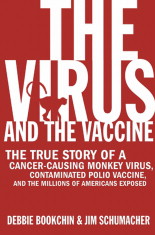
In The Virus and the Vaccine: The True Story of a Cancer-Causing Monkey Virus, Contaminated Polio Vaccine, and the Millions of Americans Exposed, Debbie Bookchin and Jim Schumacher report that in 1960, when Eddy presented her results to her boss, a polio vaccine champion named Joe Smadel, he was livid and disbelieving: “Its implications—that something in the polio vaccine could cause cancer—was an affront to his career.” Her discovery also threatened one of the USA’s most important public-health programmes. “By 1960, tens of millions of Americans had been vaccinated against polio, and it was federal health policy that everyone should be vaccinated and continue to receive Salk booster shots.”
Continue reading “You really DO NOT want to take a monkey vaccine”