The coronavirus outbreak has infected “34 White House staffers and other contacts” in recent days, according to an internal government memo, an indication that the disease has spread among more people than previously known in the seat of American government. Dated Wednesday and obtained by ABC News, the memo was distributed among senior leadership at FEMA, a branch of the Department of Homeland Security and the agency responsible for managing the continuing national response to the public health disaster. The memo also notes that a senior adviser to the president is among those infected. Hope Hicks and Stephen Miller, both senior aides to the president, have tested positive in recent days.
The new figures underscore both the growing crisis in the White House and the lengths to which government officials have gone to block information about the outbreak’s spread.
ABC News had previously reported that a total of 24 White House aides and their contacts had contracted the virus. It was not clear in the FEMA memo with the larger number what “other contacts” referred to.
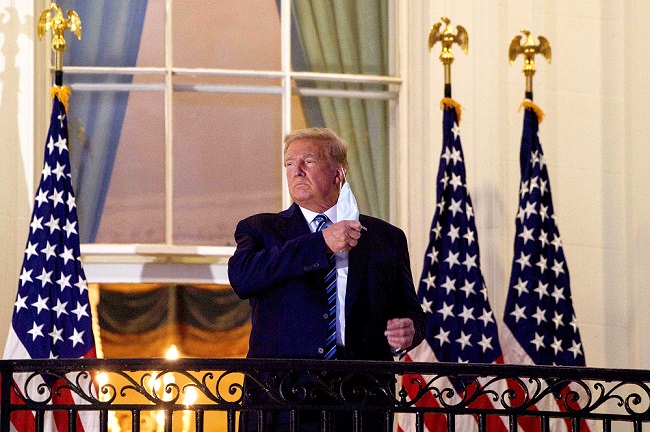
When President Donald Trump returned to the White House on Tuesday, he immediately removed his mask before entering the building — setting off concern that his behavior may put staffers, complex workers and Secret Service agents at risk.
On Tuesday, White House Communications Director Alyssa Farah said the White House was “taking precautions” to stem the spread and that those still working in the West Wing “feel comfortable.”
But on Wednesday, images emerged showing several White House aides interacting in close proximity with one another without masks.
(Bloomberg) — A top White House security official, Crede Bailey, is gravely ill with Covid-19 and has been hospitalized since September, according to four people familiar with his condition.
Anthony Fauci, the nation’s leading infectious diseases expert, said Tuesday that as many as 400,000 Americans could die from COVID-19 if action isn’t taken in the fall and winter. Fauci told attendees of a virtual event held by American University that between 300,000 and 400,000 could die from coronavirus in the country. “The models tell us if we don’t do what we need to in the fall and winter, we could have 300,000-400,000 COVID-19 deaths,” American University quoted the director of the National Institute of Allergy and Infectious Diseases as saying.
Looking ahead, “The models tell us if we don’t do what we need to in the fall and winter, we could have 300,000-400,000 #COVID19 deaths,” Fauci says. #KPUxFauci
— American University (@AmericanU) October 6, 2020
Fauci’s prediction goes beyond a University of Washington study from August that said as many as 300,000 people could die of COVID-19 by Dec. 1. As of Wednesday morning, the U.S. has recorded 210,918 deaths and more than 7.5 million confirmed infections of COVID-19, according to data from Johns Hopkins University. Fauci also asserted on Tuesday that a vaccine will probably not be available to most Americans until next summer or the fall, aligning with Centers for Disease Control and Prevention Director Robert Redfield’s Senate testimony last month. Fauci said during an event on Monday that this means life may not return to normal until the end of next year. At the American University virtual event, Fauci acknowledged the decreasing trust in him as a public official, especially among Republicans and those who believe the country needs to reopen fully. “Maybe 50 percent of you hate me because you think I’m trying to destroy the country, but listen to me for six weeks or so, and do what I say, and you’ll see the numbers go down,” Fauci pleaded, according to the university.
Regarding people who are skeptical of him, Fauci says, “Maybe 50% of you hate me because you think I’m trying to destroy the country, but listen to me for six weeks or so, and do what I say, and you’ll see the numbers go down” #KPUxFauci
— American University (@AmericanU) October 6, 2020
His comments come after President Trump announced a positive coronavirus test last week and spent three nights in Walter Reed National Military Medical Center for treatment. The president returned to the White House on Monday.
Footage suggests Trump was short of breath during maskless photo op at White House
President Trump isn’t the picture of health he’s making himself out to be, White House aides tell The New York Times. After returning from Walter Reed Medical Center on Monday after his COVID-19 diagnosis and three-day stay, Trump removed his face mask defiantly before entering the White House. Aides say it was supposed to be Trump’s display of strength after his hospital visit, even though it put everyone around him at risk because he was still contagious with the virus. “But they also wondered if the face covering was making it harder for the president to breathe,” the Times reports. The next day, aides said Trump’s voice was stronger than it had been the night before, “but at times he still sounded as if he was trying to catch air,” the Times writes. Aides, including White House Communications Director Alyssa Farah, publicly said they were “comfortable working here” as more and more White House workers tested positive for the virus. They brought in masks, gloves, and eye protection for anyone planning to work closely with Trump, including in the Oval Office. “But many saw the situation as spiraling out of control” as the pandemic Trump brushed off “seemed to have locked its grip on the White House,” the Times writes. And as polls continued to show Democratic nominee Joe Biden triumphing over Trump, aides were reportedly “worried that they were living through the final days of the Trump administration.”
(CNN)The top US general, Joint Chiefs of Staff Chairman Mark Milley, and several members of the Pentagon’s senior leadership are quarantining after a top Coast Guard official tested positive for coronavirus, several US defense officials tell CNN. The Pentagon is “conducting additional contact tracing and taking appropriate precautions to protect the force and the mission,” after vice commandant of the US Coast Guard, Adm. Charles Ray, tested positive on Monday, according to Jonathan Hoffman, assistant to the secretary of defense for public affairs.
Despite efforts by the Pentagon to stress that military leaders can carry on business as usual from quarantine, the prospect of the virus spreading among senior officials who work in one of the world’s largest office buildings will likely raise major national security questions, particularly as it follows a major outbreak in the White House that hospitalized President Donald Trump and after three Republican senators tested positive in recent days.
We are aware that Vice Commandant Ray has tested positive for COVID-19 and that he was at the Pentagon last week for meetings with other senior military leaders. Some meeting attendees included other Service Chiefs,” Hoffman said in a statement Tuesday. “Out of an abundance of caution, all potential close contacts from these meetings are self-quarantining and have been tested this morning. No Pentagon contacts have exhibited symptoms and we have no additional positive tests to report at this time,” he added. The Coast Guard is also taking precautions after Ray tested positive, “following established policies for COVID, per CDC guidelines, to include quarantine and contact tracing,” the service announced Tuesday.
“According to CDC guidelines, any Coast Guard personnel that were in close contact will also quarantine. In accordance with established Coast Guard COVID policies, Admiral Ray will be quarantining from home,” the statement said.
Secretary of Defense Mark Esper is not quarantining after returning from an overseas trip on Sunday. He participated in an event with his Bulgarian counterpart on Tuesday.
Close contact with senior Pentagon leaders
Ray was at the White House on September 27 for the Gold Star Mothers Event, the Coast Guard confirmed to CNN. Milley also attended .
Additionally, Ray was at the Pentagon on Friday and recently attended several meetings in secure areas with other members of the Joint Chiefs of Staff who are the military’s most senior generals. Multiple defense officials tell CNN that senior Pentagon leadership who had been in proximity to Ray have been tested and are awaiting results.
The self-quarantining by senior leadership goes beyond the Joints Chiefs staff due to exposure at multiple meetings in recent days, including a meeting in the Pentagon’s secure meeting space for classified information known as “the tank,” the defense official said. All but one member of the Joint Chiefs of Staff is now self-quarantining and they have tested negative as of Tuesday afternoon with none currently having symptoms, the official added. The commandant of the Marine Corps was not in the meetings with Ray; his deputy was in attendance. As a precaution, Milley is working from home, a defense official says. As Trump’s top military adviser, he maintains a full classified communications suite in his house, the official said.
The chief of staff of the US Air Force, Charles Brown, the chief of naval operations, Adm. Michael Gilday, and the chief of space operations, Gen. John Raymond, also are all working from home, according to several officials.
Additional officials working from alternate locations or from home include:
Gen. John Hyten, vice chairman of the Joint Chiefs of Staff;
Gen. James McConville, chief of staff of the Army;
Gen. Daniel Hokanson, chief of the National Guard;
Gen. Paul Nakasone, commander of US Cyber Command and director of the National Security Agency;
Gen. Gary Thomas, assistant commandant of the US Marine Corps,
WASHINGTON (Reuters) – White House senior adviser Stephen Miller said he had tested positive for COVID-19 on Tuesday, the latest case of coronavirus reported among Donald Trump’s inner circle since the Republican president announced he had the virus last week. “Over the last 5 days I have been working remotely and self-isolating, testing negative every day through yesterday,” Miller said in a statement.”Today, I tested positive for COVID-19 and am in quarantine.” Trump returned to the White House on Monday after three nights in a military hospital, urging Americans not to be afraid and not to let the coronavirus dominate their lives. The pandemic has killed more the 210,000 people in the United States, more than any other country. White House Deputy Press Secretary Brian Morgenstern told CNN late on Tuesday that there were no new COVID cases in the White House beside Miller. Trump said on Friday that he and first lady Melania Trump had tested positive for the coronavirus. Others announcing they had tested positive in recent days include close Trump adviser Hope Hicks; White House spokeswoman Kayleigh McEnany; Trump’s campaign manager Bill Stepien; and Republican Senators Mike Lee, Thom Tillis and Ron Johnson. Miller’s wife, Katie Miller, who is a spokeswoman for Vice President Mike Pence, tested positive for the virus in May.
Brokers have learned that changing the margin requirement and blowing you out in the middle of the night tilts the field towards them. Imagine if your margin requirement was 5% of what it is now. Imagine if the contract never expired. Then the trading field is leveled again and you’re fighting the market, not broker tricks.
I’m in the information business. I have to take in to put out. These are incredible times that we could describe as explosive. As you know we closed out one of our major trades on Thursday. On Friday I wasn’t looking so smart but on Monday and Tuesday if we would have stayed in we would have been creamed.
The top U.S. public health agency said Monday that the coronavirus can spread more than 6 feet through the air, especially in poorly ventilated and enclosed spaces. But agency officials maintained that such spread is uncommon and current social distancing guidelines still make sense.
However, several experts faulted the updated Centers for Disease Control and Prevention guidance. They said the virus can spread more easily than the CDC seems to be indicating, and suggested that the public should wear masks even in prolonged outdoor gatherings when they are more than 6 feet apart.
The virus “is traveling through the air and there is no bright line. You’re not safe beyond 6 feet. You can’t take your mask off at 6 feet,” said Dr. Donald Milton of the University of Maryland School of Public Health. For months, the CDC has said that the virus spreads mainly through small airborne droplets when an infected person coughs or sneezes. Most CDC guidance about social distancing is built around that idea, saying that 6 feet is a safe buffer between people who are not wearing masks.
In interviews, CDC officials have also acknowledged growing evidence that the virus can sometimes spread on even smaller particles called aerosols that spread over a wider area. In the update posted on its website, the agency again acknowledged recent research showing people with COVID-19 infected others who were more than 6 feet away or shortly after an infected person left an area. CDC officials called those ”limited, uncommon circumstances.” In those cases, spread occurred in poorly ventilated and enclosed spaces where people were doing activities that caused heavier breathing, like singing or exercise, CDC officials said. People can protect themselves by staying at least 6 feet away from others, wearing a mask, washing their hands, cleaning touched surfaces and staying home when sick Last month, the CDC ignited controversy among experts when it quietly posted an update that seemed to suggest the agency’s position had changed, and then within days took it down again. The short-lived post said the virus can remain suspended in the air and drift more than 6 feet, and officials emphasized the importance of indoor ventilation. It also added singing and breathing to the ways the virus can go airborne. Federal health officials later said the post was a mistake and that it had been released before full editing and clearance was completed. They said there was no major change in the agency’s position, but they would finalize a post to clarify the CDC’s thinking. That’s what was posted Monday. A small group of researchers — including Milton — on Monday published a letter in the journal Science that called for clearer public health guidance about how coronavirus spreads in the air. They said health officials need to use clearer language in talking about the size of airborne particles and droplets that can spread the disease, and be more straightforward about the role that viruses in small aerosols can play in infecting people. Masks and good ventilation are crucial indoors. But they can be important outdoors too, said Linsey Marr of Virginia Tech.
he pharmaceutical company Eli Lilly has claimed a drug known as a monoclonal antibody helped COVID-19 patients get rid of symptoms faster than those on a placebo. Eli Lilly said data collected from an ongoing Phase 2 clinical trial provided a proof of concept that giving LY-CoV555 to COVID-19 outpatients with a mild-to-moderate form of the disease also appeared to make them less likely to need hospital treatment, and cleared the virus faster. The interim findings of the ongoing trial were not published in a scientific journal, meaning they have not been through the rigorous peer review process. The company said it plans to publish its results in a peer-reviewed journal. Antibodies are proteins that are part of the immune system. Made by white blood cells, they recognise pathogens, like viruses or bacteria, and stick to them. They ultimately help the body neutralize and clear invaders. Monoclonal antibodies are lab-made molecules that mimic our natural antibodies. They are used to treat conditions such as cancer, rheumatoid arthritis, multiple sclerosis, cardiovascular disease, Crohn’s disease, psoriasis, and ulcerative colitis. The drugs are relatively expensive and difficult to manufacture.
What did Eli Lilly find?
The on-going trial involved 452 participants, 302 on the monoclonal antibody and 150 placebo patients. The company hopes to enroll 800 participants in total.The rate of hospitalization and emergency room visits for coronavirus among participants was 1.7 percent for those who took LY-CoV555, and 6 percent for those who were given the placebo, amounting to a 72 percent reduction in risk in the participants, according to Eli Lilly. The majority of patients, including those taking the placebo, had almost totally cleared the virus by day 11. But participants given a 2,800 mg dose of LY-CoV555 saw their viral levels drop by day three. The patients taking LY-CoV555 appeared to see their symptoms improve faster than those given the placebo. No serious adverse side effects were reported, and the drug was well-tolerated, the team said.
“The results reinforce our conviction that neutralizing antibodies can help in the fight against COVID-19,” Daniel Skovronsky, Lilly’s chief scientific officer and president of Lilly Research Laboratories, said in a statement. “
These interim data from the BLAZE-1 trial suggest that LY-CoV555, an antibody specifically directed against SARS-CoV-2, has a direct antiviral effect and may reduce COVID-related hospitalizations.” Experts not involved in the research welcomed the findings. Andrew Preston, an expert in microbial pathogenesis at the University of Bath in the U.K., told Newsweek the findings were positive but preliminary. “A treatment that helps to reduce the severity of COVID-19 disease is very welcome,” he said. Preston said: “The trial contained only small numbers of patients who progressed to more serious disease, as only 6 percent of the control group reached this endpoint. This suggests that the trial tested the treatment on those with relatively mild disease, or that other treatments administered to patients were effective at preventing disease progression. Other discussions of MAb [monoclonal antibody] therapy have focused on its use to treat the most ill patients, this has yet to be tested. “Interestingly, only one dose proved to have significant effect and it was the middle dose, not the highest dose. It will be important to determine why the high dose was not effective, as it appears that giving a specific level of antibody is important and it’s not clear if this level varies among individuals.” Myron Cohen, director of the Institute for Global Health and Infectious Diseases at the University of North Carolina at Chapel Hill, told The New York Times the results were “really compelling” and the trial seemed to be rigorous.