Two German schools shut again after new cases

Two schools in northeast Germany have closed due to coronavirus infections, state authorities announced on Friday. Both schools, the Ostsee elementary school and the Goethe High School, are in the state of Mecklenburg-West Pomerania. This was the first German state to re-open for classes, at the beginning of this week following the summer holidays. In one of the schools, the Goethe High School, a teacher tested positive for the virus but had not yet given any lessons to students, the district of Ludwigslust-Parchim, where the school is located, announced on its website. The school will remain shut until next Wednesday and all 55 teachers will be also be tested, local authorities said.

“Safety first! We will continuously inform parents, teachers and students about new developments,” Mayor Stefan Sternberg said in a statement on the district’s official website.

In the second school, the Ostsee Elementary School in the district of greater Rostock, a student tested positive for Covid-19, according to local authorities. Rostock district said in a press release that all students and staff will be quarantined.

“The students will not be going to school for a limited amount of time. Our safety concept has the aim of reacting precisely and locally to any possible infection without having to resort to large scale school closures,” Mecklenburg-West Pomerania’s Education Minister Bettina Martin said in a statement published by state authorities.

On Thursday the German government voiced concern over a recent spike in infections across the country, and urged citizens to follow pandemic rules like social distancing, mask wearing and sanitizing more closely.
US Approaches 5 Million Confirmed Cases of COVID-19

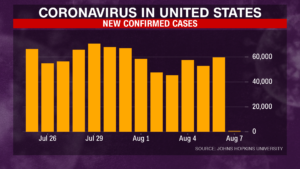
The US has recorded more than 4,880,000 cases of coronavirus since the pandemic began, according to the latest tally from John Hopkins University The country often records more than 40,000 new cases daily — and sometimes more than 60,000. That means the US is on track to soon surpass 5 million total cases.

Here’s a look at new daily cases for the past two weeks:


30 Positive For COVID-19 After Funeral: All wore masks and social distaced

https://cbsloc.al/2XDakml

https://w3.cdn.anvato.net/player/prod/v3/anvload.html

MINNEAPOLIS (WCCO) — It’s human nature to want to gather and grieve together when someone you lose someone close to you, but the COVID-19 pandemic is making that more difficult. Kathleen Keen and her husband learned that first hand. They were at a funeral for a friend’s father in northern Minnesota in Mid-July. Shortly after, both she and her husband tested positive for COVID-19. What’s more is that they weren’t alone — 29 of the 35 people at the service tested positive.

Everyone wore masks and socially distanced until they got to the social hour after the service.

“It was in this fellowship hall and I remember looking at the windows and wishing I could open them. Like, ‘This is not good that everyone is packed together in this room,’” Keen said. “I don’t regret making the choice to be there for my friend. I wish this virus wasn’t happening.” Keen hopes her story can act as a warning about how serious COVID-19 can be, and how important it is to take safety precautions, especially if you’re going to be in a crowd.

Trump: We are going a different way on stimulus

President Trump announced that he planned to sign executive actions that the White House is drafting to address expired unemployment insurance and to suspend payroll taxes, as congressional negotiations for coronavirus aid continue to drag on. Speaking to reporters Thursday, Trump said the orders could be signed Friday afternoon or Saturday morning. He said a legislative deal was still possible, however. “Probably tomorrow afternoon. They’re being drawn now,” Trump said when asked when the executive orders would be signed. “We’ll see what happens. It’s possible we’ll make a deal, but it’s also possible we won’t. But I would say probably tomorrow afternoon or maybe the following morning.” The president is traveling to Ohio, where he is expected to sign a long-awaited “Buy American” order requiring the government to buy essential medicines and medical supplies from U.S. manufacturers. In a tweet before leaving the White House, Trump said he had instructed the White House to “continue working on an Executive Order with respect to Payroll Tax Cut, Eviction Protections, Unemployment Extensions, and Student Loan Repayment Options.” Trump has pressed repeatedly for a payroll tax cut, a move backed by outside economic adviser Stephen Moore, a Washington Examiner columnist, but among lawmakers, the cut is less popular. A federal moratorium on evictions expired at the end of July, exposing tenants of more than 12 million rental units to eviction should they miss a payment. A $600-per-week supplement to unemployment benefits that passed as part of the CARES Act in March has also expired. Negotiations on a potential fourth stimulus bill have been underway for nearly two weeks; however, Democrats and the White House remain “trillions” of dollars apart, White House chief of staff Mark Meadows and Treasury Secretary Steven Mnuchin said Thursday. Meadows said Thursday that Trump would take executive actions on unemployment aid and evictions if a deal could not be reached by the end of the week. “At this point, either we’re going to get serious about negotiating and get an agreement in principle, or it becomes extremely doubtful that we’ll be able to make a deal if it goes well beyond Friday,” he said. Senate Majority Leader Mitch McConnell, a Kentucky Republican, said on Thursday that Democrats were to blame for the lack of progress and that the chamber would be in session Monday. “The only thing that gets an outcome is the speaker and the president of the United States reaching an agreement,” McConnell said on Fox News on Wednesday. “And once they do that, I believe that the majority of my members will support it, but not every single one of them. I’ve been clear about that from the beginning.”

Dr. Anthony Fauci says chance of coronavirus vaccine being highly effective is ‘not great’

  • White House coronavirus advisor Dr. Anthony Fauci that the chances of scientists creating a highly effective vaccine — one that provides 98% or more guaranteed protection — for the virus are slim.
  • Scientists are hoping for a coronavirus vaccine that is at least 75% effective, but 50% or 60% effective would be acceptable, too, he said.
  • The FDA has said it would authorize a coronavirus vaccine so long as it is safe and at least 50% effective.

White House coronavirus advisor Dr. Anthony Fauci said Friday that the chances of scientists creating a highly effective vaccine — one that provides 98% or more guaranteed protection — for the virus are slim. Scientists are hoping for a coronavirus vaccine that is at least 75% effective, but 50% or 60% effective would be acceptable, too, Fauci, director of the National Institute of Allergy and Infectious Diseases, said during a Q&A with the Brown University School of Public Health. “The chances of it being 98% effective is not great, which means you must never abandon the public health approach.” “You’ve got to think of the vaccine as a tool to be able to get the pandemic to no longer be a pandemic, but to be something that’s well controlled,” he said. The Food and Drug Administration has said it would authorize a coronavirus vaccine so long as it is safe and at least 50% effective. Dr. Stephen Hahn, the FDA’s commissioner, said last month that the vaccine or vaccines that end up getting authorized will prove to be more than 50% effective, but it’s possible the U.S. could end up with a vaccine that, on average, reduces a person’s risk of a Covid-19 infection by just 50%. “We really felt strongly that that had to be the floor,” Hahn said on July 30, adding that it’s “been batted around among medical groups.” “But for the most part, I think, infectious disease experts have agreed that that’s a reasonable floor, of course hoping that the actual effectiveness will be higher.” A 50% effective vaccine would be roughly on par with those for influenza, but below the effectiveness of one dose of a measles vaccination, which is about 93% effective, according to the Centers for Disease Control and Prevention. Public health officials and scientists expect to know whether at least one of the numerous potential Covid-19 vaccines in development worldwide is safe and effective by the end of December or early next year, though there is never a guarantee. Drug companies Pfizer and Moderna both began late-stage trials for their potential vaccines last week and both expect to enroll about 30,000 participants.

Fauci has previously said he worries about the “durability” of a coronavirus vaccine, saying if Covid-19 acts like other coronaviruses, it may not provide long-term protection.

Health officials say there is no returning to “normal” until there is a vaccine. Fauci’s comment came a day after the World Health Organization cautioned about the development of vaccines, reiterating that there may never be a “silver bullet” for the virus, which continues to rapidly spread worldwide. The phase three trials underway do not necessarily mean that a vaccine is almost ready to be deployed to the public, the agency said. “Phase three doesn’t mean nearly there,” Mike Ryan, executive director of the WHO’s emergencies health program, said during a virtual panel discussion with “NBC Nightly News” Anchor Lester

Will advise Trump to sign aid executive orders – Mnuchin

EPA-EFE/KEVIN DIETSCH

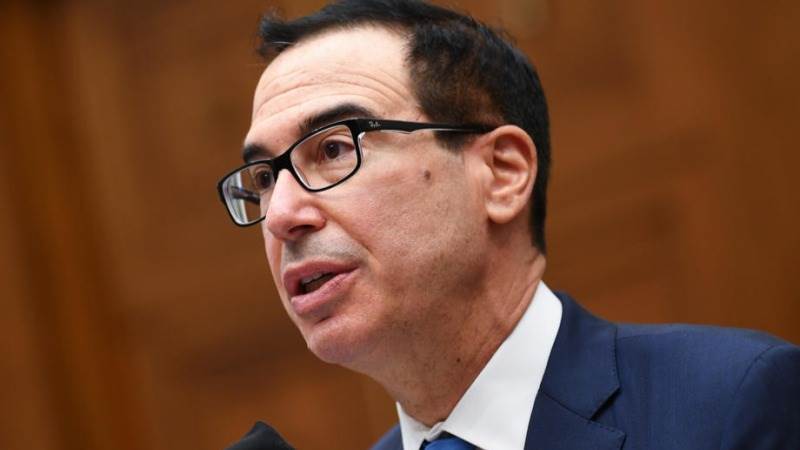
United States Treasury Secretary Steven Mnuchin said on Friday he will recommend President Donald Trump to proceed with signing executive orders on the matters of unemployment insurance, evictions, student loans, and a payroll tax, aimed at combating the economic crisis caused by the coronavirus pandemic.

Mnuchin explained he made this decision after today’s 90-minute negotiations on the aid package between him, White House Chief of Staff Mark Meadows, House Speaker Nancy Pelosi, and Senate Majority Leader Chuch Schumer did not make “any progress.” Pelosi also previously commented the White House and Democrats are “still far apart” on reaching a new stimulus deal to support the economy. White House chief of staff Mark Meadows and Treasury Secretary Steven Mnuchin said President Trump should sign executive orders unilaterally addressing coronavirus stimulus spending after negotiations with congressional Democrats stalled again on Friday.

Why it matters: Friday was viewed as a self-imposed deadline to negotiate a new relief bill. But after an intense week of negotiations on Capitol Hill, White House and Democratic leadership failed to reach a deal on delivering much needed aid to Americans and businesses.

  • Trump’s team has already drafted a series of orders that would implement a payroll tax holiday, address the housing crisis, provide more aid for student loans and make more money available for enhanced unemployment benefits.
  • Trump is expected to sign the orders over the weekend.
  • Meadows: “At this point I’m extremely disappointed we came up here today just to hear same thing over and over again the same thing as the last two weeks.”
  • Mnuchin: “The chief and I will recommend to the president based upon our lack of activity today to move forward with some executive orders — again, we agree with the Speaker, this is not the first choice.”
  • Senate Minority Leader Chuck Schumer: “It was a disappointing meeting. We reiterated in very strong terms our offer. We’ve come down $1 trillion from our top number … Unfortunately, they rejected it. They said they couldn’t go much above their existing $1 trillion and that was disappointing.”
  • House Speaker Nancy Pelosi said that Democrats view these talks as an “opportunity” to deliver for the American people, “but we can’t have it be a missed opportunity to do that by settling for something so low, so beneath meeting the needs of the American people.”

What’s next: All leaders said they are willing to continue negotiations if the opposing party is open to compromise, but several lawmakers are wary that they’ll be able to find common ground.

US job cuts up 54% in July – Challenger


The number of job cuts in the United States in July was 54% higher than in June, according to a report by Challenger, Gray & Christmas Inc. published on Thursday. There were 262,649 dismissals in July, representing a 576% surge on an annual basis.

The year-to-date figure reached 1,847,696, rising by 212% from the 592,556 recorded in the same timeframe last year. The market conditions caused 77,092 layoffs, followed by 63,517 dismissals due to the coronavirus pandemic, while 60,831 people lost their jobs in July because of the demand downturn. This year, 1,074,904 cuts in total have been attributed to COVID-19.

“The downturn is far from over, especially as COVID cases rise around the country. Consumers are buying fewer goods and services, businesses are closing, and bankruptcies are rising,” Senior Vice President of Challenger, Gray & Christmas Inc. Andrew Challenger noted.

July’s job cuts brought the total so far this year to 1.848 million, up 212% from the same period in 2019. The year-to-date layoffs are just 109,180 away from the record 1.957 million job cuts announced in 2001.

The weak labor market data raises the risk of a sharper slowdown in job growth in July. The Labor Department will publish its closely watched, and broader, monthly employment report on Friday. According to a Reuters survey of economists, nonfarm payrolls likely increased by 1.6 million in July, down from the record 4.8 million jobs created in June.

According to Challenger, Gray & Christmas, COVID-19 was cited as the reason for 63,517 job cuts in July. The respiratory illness has been blamed for 1.075 million layoffs so far this year. The balance of job cuts in July were attributed to market conditions, a downturn in demand and bankruptcies.

Several retailers including J.C. Penney and Lord & Taylor have filed for bankruptcy since March. Job cuts remained concentrated at bars, restaurants, hotels and amusement parks. The automotive sector cut 83,853 jobs. Hiring announcements totaled 246,507 in July, almost matching layoffs.

“It is clear that many job losses are now permanent, and it will be challenging for many workers to find new jobs and feel safe taking jobs that are public-facing,” said Challenger.

Dr. Osterholm: Americans will be living with the coronavirus for decades


Osterholm’s viewpoint is sobering. The 67-year-old expects the novel coronavirus to be present for the rest of his life. He doesn’t believe the wave theory (a first wave, a lull, followed by other waves) will apply to this pandemic. “That’s not what’s happening here,” he told MarketWatch in an interview.

MarketWatch: One of the things I’m pretty interested in is the talk and the hope around a vaccine. Do you think we have misconceptions about what it means when we have a vaccine?

Michael Osterholm: Everyone is looking at the vaccine as being a light switch: on or off. And I look at it as a rheostat, that’s going to take a long time, from turning it on from its darkest position to a lightest position. If you’re anticipating a light switch, you’re going to be concerned, confused, and in some cases very disappointed in what it might look like in those first days to months with a vaccine.

MarketWatch: I saw a piece in The Atlantic this week and I thought they positioned it well. They described it as the beginning of the end.

Osterholm: It won’t be. We will be dealing with this virus forever. Effective and safe vaccines and hopefully ones with some durability will be very important, even critical tools, in fighting it. But the whole world is going to be experiencing COVID-19 ‘til the end of time. We’re not going to be vaccinating our way out of this to eight-plus billion people in the world right now. And if we don’t get durable immunity, we’re potentially looking at revaccination on a routine basis, if we can do that. We’ve really got to come to grips with actually living with this virus, for at least my lifetime, and at the same time, it doesn’t mean we can’t do a lot about it.

MarketWatch: Do you think we’re going to see some of these vaccines fail in clinical studies?

Osterholm: One of the challenges we have is: what do we mean by fail? What’s the definition? Some people right now have a view that any vaccine that isn’t like the measles vaccine is going to be a challenge, meaning they’ve got to work 93% to 98% of the time. I don’t think there’s any sense that that’s going to happen with this vaccine. That doesn’t mean that there isn’t going to be an effective vaccine at 50%, 60% or 70%.

We have to keep watching for safety signals. We have to make sure that over time we can assure the public with open and transparent data that: This is what you can expect in terms of reactions, this is what might have any long-term complications.

MarketWatch: When it comes to how medical information is being disseminated, there have been a lot of changes. You’ve done some peer review and work with journals. Do you think some of these preliminary scientific writings are being shared with the public too soon?

Osterholm: Oh, absolutely. We’re drinking from a fire hose right now in terms of new information. You can make the case that’s important because we’re in a position to learn things that could have a very real impact on patient outcome and therefore getting the data out are critical. But then there’s a downside to that, too, because with that comes an increasing amount of marginal if not potentially erroneous information.

MarketWatch: Do you think we’re going to see distinct waves of outbreaks in the U.S.?

Continue reading “Dr. Osterholm: Americans will be living with the coronavirus for decades”

NYC health commissioner quits over de Blasio’s COVID-19 response

New York City’s top public health official resigned Tuesday, accusing Mayor Bill de Blasio (D) of sidelining medical experts in the midst of a pandemic that has hit America’s largest city especially hard. In an emailed resignation letter, Health Commissioner Oxiris Barbot said she quit with “deep disappointment that during the most critical public health crisis in our lifetime, that the Health Department’s incomparable disease control expertise was not used to the degree it could have been.” “Our experts are world renowned for their epidemiology, surveillance and response work. The city would be well served by having them at the strategic center of the response not in the background,” Barbot wrote in an email first reported by The New York Times.

In an email to staffers, Barbot praised the agency as the gold standard in public health. “As I shared with the Mayor, your world class skills are what make this agency so respected around the globe,” Barbot told her colleagues. “Your experience and guidance have been the beacon leading this city through this historic pandemic and that to successfully brace against the inevitable second wave, your talents must be better leveraged alongside that of our sister agencies.”

Barbot has repeatedly clashed with de Blasio since the beginning of the pandemic. In May, the mayor stripped the health department of its authority over a massive contact tracing program, teams the department had led in past crises.

Nearly a quarter-million New York City residents have tested positive for the coronavirus, which began spreading widely through the city in March. At its peak in early April, more than 6,000 people were testing positive every day. Almost 19,000 have died, a steeper toll than any single state in the nation. The number of new cases has plummeted in recent weeks. On July 31, the last day for which data is available, just 82 New Yorkers tested positive. De Blasio on Tuesday appointed Dave Chokshi, a population health and medicine expert at NYU’s School of Medicine, to replace Barbot. Chokshi has been aiding the city’s response to the coronavirus outbreak.

“Dr. Chokshi has spent his career fighting for those too often left behind,” de Blasio said in a statement after Barbot’s resignation. “Never has that been more true than during the Covid-19 pandemic, where he has helped lead our City’s public health system under unprecedented challenges. I know he’s ready to lead the charge forward in our fight for a fairer and healthier city for all.”

Chokshi served as a White House fellow during the Obama administration and as a top health adviser to the secretary of Veterans Affairs.

New York City’s Department of Health and Mental Hygiene is one of the most prominent and practiced health departments in the world. Two former commissioners, David Sencer and Tom Frieden, went on to run the Centers for Disease Control and Prevention.