DETROIT (Reuters) – The Detroit Three automakers will shut down their U.S. plants to stop the spread of coronavirus, bowing to pressure from the union representing about 150,000 hourly workers at those facilities, industry officials said.
Ford Motor Co (F.N), General Motors Co (GM.N) and Fiat Chrysler Automobiles NV (FCHA.MI) (FCAU.N) confirmed the decisions to shut U.S. plants, as well as factories in Canada and Mexico.
The Detroit automakers’ shares took a beating on Wednesday, with GM closing 17.3% lower, Ford off 10.2% and Fiat Chrysler shares ending 9.2% lower in New York. The carmakers’ North American factories build their most profitable trucks and sport utility vehicles, such as Fiat Chrysler’s Jeep Wrangler, GM’s Chevrolet Silverado pickup and the Ford F-series truck line.
The actions come less than a day after the automakers and the United Auto Workers union agreed to keep plants running with reduced shifts and staffing, and more time allowed for cleaning.
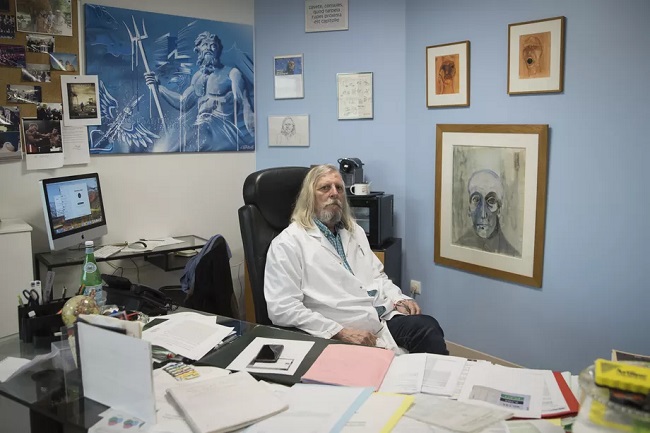
Professor Didier Raoult, director of the Mediterranean Institute of Infection, poses for a portrait in his office at La Timone hospital in Marseille, Southern France
An acclaimed research professor in France revealed successful results of a potential treatment for COVID-19, the coronavirus.
What’s going on:
Professor Didier Raoult, who works for the infection hospital l’Institut Hospitalo-Universitaire (IHU) Méditerranée Infection in Marseille, published a new video in which he explained that the COVID-19 patients who were treated “with the drug chloroquine had seen a rapid and effective speeding up of their healing process, and a sharp decrease in the amount of time they remained contagious.”
Chloroquine has previously been used to prevent and treat malaria.
The drug was offered to 24 patients, who were among the first 24 to become infected in France’s southeastern region.
Patients were given the drug for 10 days. Researchers monitored the patients since the drug can cause severe side effects.
Raoult said those who did not receive the drug were still contagious after six days. Those who tried the drug were only 25% contagious, though.
The Senate passed the House’s coronavirus aid package on Wednesday, sending it to President Trump, who is expected to sign it. Senators voted 90-8 on the bill that passed the House in a middle-of-the-night Saturday vote but needed dozens of pages of corrections and changes, which cleared the chamber on Monday. The measure, which the Joint Committee on Taxation estimates will cost $104 billion, is the second package that Congress has passed amid growing concerns about the widespread coronavirus outbreak in the United States that has already bludgeoned the economy. The vote on the second package comes as senators are already working on “phase three,” with Senate Republicans wanting to pass next tranche next week. The third coronavirus bill is expected to include help for impacted small businesses, industries and families, including direct cash payments for Americans. McConnell has created GOP task forces for drafting the bill. Republicans briefed their colleagues during a closed-door lunch on Wednesday and are expected to hand over their work product by Thursday. The majority leader told reporters after a closed-door lunch that Republicans were “getting close” and “hoping to be together shortly.” The bill approved Wednesday bolsters unemployment insurance and guarantees free diagnostic testing for the coronavirus.It also provides up to 10 days of paid sick leave for some workers. It caps that at companies with 500 employees and would allow for those with fewer than 50 to apply for a waiver. But the bill’s path through the Senate wasn’t without drama. The House bill, which was negotiated by Speaker Nancy Pelosi (D-Calif.) and Treasury Secretary Steven Mnuchin, sparked fierce opposition from some Senate Republicans, who were largely sidelined from the talks. Senate Majority Leader Mitch McConnell (R-Ky.) tipped his hand to the frustration ahead of Wednesday’s vote. “I will vote to pass their bill. This is a time for urgent bipartisan action, and in this case, I do not believe we should let perfection be the enemy of something that will help even a subset of workers,” McConnell said. “However, the House’s bill has real shortcomings. It does not even begin to cover all of the Americans who will need help in the days ahead,” he added. Continue reading “Senate passes House’s coronavirus aid bill, sending it to Trump”
WASHINGTON – President Donald Trump confirmed that he plans to invoke a provision that would allow him to prohibit certain people from entering the country, including asylum seekers and those entering the country illegally at the southern border. “The answer’s yes,” Trump told reporters when asked about the code, adding that he plans to invoke it “very soon. Probably today.” The administration will invoke 42 U.S. Code 265, a section of the federal legal code that states the U.S. surgeon general “shall have the power to prohibit, in whole or in part, the introduction of persons and property from such countries or places as he shall designate in order to avert such danger, and for such period of time as he may deem necessary for such purpose.” President Donald Trump said he is invoking the Defense Production Act, which allows the administration to expedite and expand the supply of resources. Trump did not say specifically what powers he would execute, but the act could allow him to step up production of respirators and other medical equipment. Trump declined to say how, precisely, the Defense Production Act would be used and he suggested that the administration is still deciding. He said the administration had “targets” for equipment it wanted but did not say what those targets were. “We need millions of masks,” Trump said. “We need respirators.” The announcement comes as the White House and Congress negotiate a trillion-dollar economic stimulus plan to combat the impacts of the coronavirus outbreak. Continue reading “Trump invokes wartime authority of Defense Production Act to address coronavirus crisis”
Members of the senior class at Colorado College holding a bittersweet celebration on Wednesday, as spring break marked the probable end of the school year because of coronavirus.Christian Murdock/The Gazette/Associated Press Scientists and government officials fighting the coronavirus epidemic say they have a problem: Carefree youths. As authorities moved to restrict social gatherings last week, bars and restaurants from New York to Berlin filled up with revelers, illegal “lockdown parties” popped up in France and Belgium, and campuses in the U.S. lit up for end-of-the-world dorm parties. So far, most young Covid-19 patients have experienced mild or no symptoms from the virus, while more severe cases are concentrated among those aged 50 and over. Data released last week by the National Health Institute in Italy, currently the world’s worst-hit country, shows mortality rates starting at 0% for patients aged 0 to 29 and edging up to peak at 19% for those over 90.
Yet scientists say tests have shown children and young adults are no less likely than older people to get infected and transmit the virus. Epidemiologists are growing concerned that the millennial pushback against social-distancing measures—and an emerging generational divide about how the disease is perceived—could undo all efforts to slow the spread of the virus and put vulnerable people at high risk. President Trump on Monday stressed that young people can spread the virus even if they only have mild symptoms and recommended that Americans avoid restaurants and gatherings of more than 10 people. French President Emmanuel Macron went further, announcing a nationwide lockdown and punishment for those who violate the rules. So far, the young don’t seem to be listening.
The medical impact of the new coronavirus is coming into sharper focus as it continues its spread in what is now officially recognized as a pandemic. Its true fatality rate isn’t yet known, but it seems 10 times higher than the flu, which kills hundreds of thousands around the world each year, the United States’ top infectious disease expert told lawmakers last week. Most people have had mild to moderate illness and recovered, but the virus is more serious for those who are older or have other health problems. That’s a huge number, said Dr. Tom Frieden, a former director of the Centers for Disease Control and Prevention who now heads a global health organization. In the U.S., 60% of adults have at least one underlying health condition and 42% have two or more. “There’s still a lot that we don’t know about the virus and disease it causes, COVID-19,” he said. Most spread is from droplets produced when an infected person coughs, which are inhaled by people nearby. Transmission from touching contaminated surfaces hasn’t been shown yet, though recent tests by U.S. scientists suggest it’s possible — one reason they recommend washing your hands and not touching your face.
The virus can live in the air for several hours, up to 24 hours on cardboard and up to two to three days on plastic and stainless steel. Cleaning surfaces with solutions containing diluted bleach should kill it.
“While we are still learning about the biology of this virus, it does not appear that there is a major risk of spread through sweat,” said Julie Fischer, a Georgetown University microbiologist. The biggest concern about going to the gym is infected people coughing on others, or contaminating shared surfaces or equipment, she said. Consider avoiding large classes and peak hours and don’t go if you’re coughing or feverish, she suggests.
The risk of virus transmission from food servers is the same risk as transmission from other infected people, but “one of the concerns is that food servers, like others facing stark choices about insurance and paychecks, may be pressured to work even if they are sick,” she said.
Each infected person spreads to two or three others on average, researchers estimate. It spreads more easily than flu but less than measles, tuberculosis or some other respiratory diseases. It is not known if it spreads less easily among children, but fewer of them have been diagnosed with the disease. A study of 1,099 patients in China found that 0.9% of the cases were younger than 15.
Dr. Marty Makary, Johns Hopkins University School of Public Health, on whether it would have made a difference if our government had acted earlier to prevent the spread of coronavirus.
Berlin is trying to stop Washington from persuading a German company seeking a coronavirus vaccine to move its research to the US, prompting German politicians to insist no country should have a monopoly on any future vaccine. Germany’s Health Ministry confirmed a report in newspaper Welt am Sonntag, which said President Donald Trump had offered funds to lure the company CureVac to the US, and the German government was making counter-offers to tempt it to stay. “The German government is very interested in ensuring that vaccines and active substances against the new coronavirus are also developed in Germany and Europe,” the newspaper quoted a Health Ministry official as saying. “In this regard, the government is in intensive exchange with the company CureVac.” Contacted by Reuters, a spokeswoman for the German Health Ministry said: “We confirm the report in the Welt am Sonntag.”
Scientists stumble on potential vaccine by ‘pure luck’ Welt am Sonntag quoted an unidentified German government source as saying Trump was trying to secure the scientists’ work exclusively, and would do anything to get a vaccine for the United States, “but only for the United States”. Continue reading “Trump wants German coronavirus vaccine only for US”
United States President Donald Trump’s coronavirus test came back negative, his personal physician revealed on Saturday. Earlier in the day, the president confirmed he took the test and that he expected the results in a day or two. According to Conley, the test was performed Friday night and the president “remains symptom-free.” Trump hosted a delegation from Brazil at Mar-a-Lago last weekend, including Brazil’s President Jair Bolsonaro and his press secretary Fabio Wajngarten, the latter of whom was confirmed as infected with the coronavirus. Bolsonaro was first reported to be infected as well, however, he later rebuffed the claims on his Facebook page.
French Prime Minister Edouard Philippe said on Saturday that all cafes, restaurants, night clubs, cinemas and non-essential businesses in the country will be ordered to shut down as of midnight to help prevent the further spread of COVID-19. The number of new coronavirus deaths in France increased by 12 to 91 on Saturday, the country’s Ministry of Health revealed. Meanwhile, the number of new registered cases jumped by 838 to 4,499 over the past 24 hours. Earlier, the World Health Organization (WHO) said the coronavirus pandemic’s epicenter has shifted to Europe with the number of cases in Italy, France and Germany surging.