Coronavirus: Nasa images show China pollution clear amid shutdown

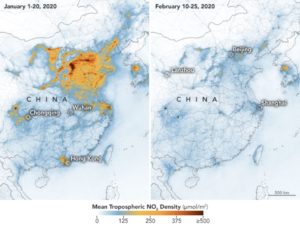
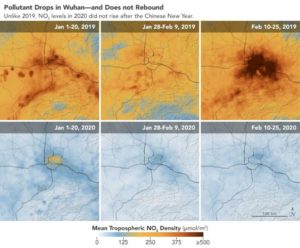
Satellite images have shown a dramatic decline in pollution levels over China, which due to an economic slowdown prompted by the coronavirus, US space agency Nasa says. Nasa maps show falling levels of nitrogen dioxide this year. It comes amid record declines in China’s factory activity as manufacturers stop work in a bid to contain the coronavirus. China has recorded nearly 80,000 cases of the virus since the outbreak began. It has spread to more than 50 countries but the vast majority of infections and deaths are in China, where the virus originated late last year. Nasa scientists said the reduction in levels of nitrogen dioxide – a noxious gas emitted by motor vehicles and industrial facilities – was first apparent near the source of the outbreak in Wuhan city but then spread across the country. Nasa compared the first two months of 2019 with the same period this year.

The space agency noted that the decline in air pollution levels coincided with restriction imposed on transportation and business activities, and as millions of people went into quarantine. “This is the first time I have seen such a dramatic drop-off over such a wide area for a specific event,” Fei Liu, an air quality researcher at Nasa’s Goddard Space Flight Center, said in a statement. She added that she had observed a decline in nitrogen dioxide levels during the economic recession in 2008, but said that decrease was more gradual. Nasa noted that China’s Lunar New Year celebrations in late January and early February have been linked to decreases in pollution levels in the past. But it said they normally increase once the celebrations are over. “This year, the reduction rate is more significant than in past years and it has lasted longer,” Ms Liu said. “I am not surprised because many cities nationwide have taken measures to minimise spread of the virus.”

Empty streets, economic turmoil as virus alters daily life

TOKYO (AP) — The coronavirus has claimed its first victim in the United States as the number of cases shot up in Iran, Italy and South Korea and the spreading outbreak shook the global economy. Governments stepped up efforts to contain the disease. Saudi Arabia closed Islam’s holiest sites to foreign pilgrims. In Japan, professional baseball teams played in deserted stadiums. The French government advised the public to forgo customary greeting kisses. Ireland and Ecuador among the countries reporting their first cases Saturday. More than 85,000 people worldwide have contracted the virus, with deaths topping 2,900. China recorded 573 new virus cases and 35 more deaths in the 24 hours through midnight Saturday, according to the National Health Commission. That raised the total for the country where the disease emerged in December to 2,870 deaths and 79,834 cases. In the United States, a man in his 50s in suburban Seattle became the first coronavirus death on U.S. soil. Officials say they aren’t sure how the man acquired the virus because he had not traveled to any affected areas. “Additional cases in the United States are likely, but healthy individuals should be able to fully recover,” President Donald Trump said. Officials announced heightened warnings about travel to certain regions of Italy and South Korea as well as a ban on travel to Iran. Many cases of the virus have been relatively mild, and some of those infected are believed to show no symptoms at all. But that can allow for easier spread, and concern is mounting that prolonged quarantines, supply chain disruptions and a sharp reduction in tourism and business travel could weaken the global economy or even cause a recession. South Korea, the second hardest hit country after China, reported 376 new cases on Sunday morning, raising its total to 3,526. Most of the cases in South Korea have been reported in the southeastern city of Daegu and nearby towns. Italian authorities say the country now has more than 1,100 coronavirus cases, with 29 deaths so far. Iran is preparing for the possibility of “tens of thousands” of people getting tested for the virus as the number of confirmed cases spiked again Saturday, an official said. So far, the virus and the COVID-19 illness it causes have killed 43 people out of 593 confirmed cases in Iran.

Researchers reported the death rate may be lower than initially feared as more mild cases are counted.

A study by Chinese researchers published Friday in the New England Journal of Medicine analyzing 1,099 patients at more than 500 hospitals throughout China calculated a death rate of 1.4%, substantially lower than earlier studies that focused on patients in the central city of Wuhan, where it started and has been most severe.

Assuming there are many more cases with no or very mild symptoms, “the case fatality rate may be considerably less than 1%,” U.S. health officials wrote in an editorial in the journal.

That would make the new virus more like a severe seasonal flu than a disease similar to its genetic cousins SARS, severe acute respiratory syndrome, or MERS, Middle East respiratory syndrome.

Also Saturday, a survey of Chinese manufacturers showed activity plunged in February by a wider margin than anticipated, adding to the virus’s mounting economic toll.

The monthly purchasing managers’ index issued by the Chinese statistics agency and an industry group fell to 35.7 from January’s 50 on a 100-point scale on which numbers below 50 indicate activity contracting.

Japanese Prime Minister Shinzo Abe announced a 270 billion yen ($2.5 billion) emergency economic package to help fight the virus. Abe said at a news conference that Japan is at critical juncture to determine whether the country can keep the outbreak under control ahead of the Tokyo summer Olympics.

Abe, who earlier announced plans to close all schools for more than a month through the end of the Japanese academic year sparked public criticism, said the package includes financial support for families and their employers affected by the closures.

“Frankly speaking, this battle cannot be won solely by the efforts of the government,” Abe said. “We cannot do it without understanding and cooperation from every one of you, including medical institutions, families, companies and local governments.”

Even in isolated, sanctions-hit North Korea, leader Kim Jong Un called for stronger anti-virus efforts to guard against COVID-19, saying there will be “serious consequences” if the illness spreads to the country.

In other areas caught up in the outbreak, eerie scenes met those who ventured outside.

Streets were deserted in the city of Sapporo on Japan’s northernmost main island of Hokkaido, where a state of emergency was issued until mid-March. Tokyo Disneyland and Universal Studios Japan announced they would close, and big events were canceled, including a concert series by the K-pop group BTS.

In France, the archbishop of Paris advised parish priests not to administer communion by placing the sacramental bread in worshippers’ mouths. Instead, priests were told to place the bread in their hands. The French government cancelled large indoor events.

Saudi Arabia closed off Islam’s holiest sites in Mecca and Medina to foreign pilgrims, disrupting travel for thousands of Muslims already headed to the kingdom and potentially affecting plans later this year for millions more ahead of the fasting month of Ramadan and the annual hajj pilgrimage.

Tourist arrivals in Thailand are down 50% compared with a year ago. In Italy, which has the most reported cases of any country outside of Asia, hotel bookings are falling. Premier Giuseppe Conte raised the specter of recession.

The head of the World Health Organization on Friday announced that the risk of the virus spreading worldwide was “very high.” U.N. Secretary-General Antonio Guterres said the “window of opportunity” for containing the virus was narrowing.

Economists have forecast global growth will slip to 2.4% this year, the slowest since the Great Recession in 2009, and down from earlier expectations closer to 3%. For the United States, estimates are falling to as low as 1.7% growth this year, down from 2.3% in 2019.

Despite anxieties about a wider outbreak in the U.S., Trump has defended measures taken and lashed out at Democrats who have questioned his handling of the threat.

Trump has accused Democrats of “politicizing” the coronavirus threat and boasted about preventive steps he’s ordered in an attempt to keep the virus from spreading across the United States.

— Klepper reported from Providence, R.I. Associated Press writers Joe McDonald in Beijing, Jon Gambrell in Dubai, United Arab Emirates, John Leicester in Paris, Deb Riechmann and Darlene Superville in Washington, Adam Geller, Joseph Pisani and Edith M. Lederer in New York, Hyung-jin Kim and Tong-hyung Kim in Seoul, South Korea, Renata Brito and Giada Zampano in Venice, Italy, Frances D’Emilio in Rome, Paul Wiseman, Christopher Rugaber in Washington, Marilynn Marchione in Milwuakee and Frank Jordans in Berlin contributed to this report.
Coronavirus unlikely to vanish next year-NIH’s Fauci

WASHINGTON, Feb 28 (Reuters) – A senior U.S. health official told lawmakers that the coronavirus that is spreading globally is unlikely to disappear next year and that many more cases should be expected in the United States, according to a source who attended a briefing on Friday.

Anthony Fauci, who heads the National Institute of Allergy and Infectious diseases, also told House of Representatives members in a closed briefing that the United States currently does not have enough coronavirus testing resources.

Trump Calls Coronavirus Fear The Dems’ ‘New Hoax’ As More Cases Confirmed

President Donald Trump accused Democrats of a new “hoax” over criticism of his handling of the coronavirus threat, as US health officials reported Friday a fourth case of novel coronavirus of unknown origin, indicating the disease was spreading in the country. The latest case is a boy under 18 in Washington State who tested “presumptive positive” and is currently in home isolation in Snohomish County. The high school he attends will be shut until March 3 while it is deep cleaned, the Washington State Department of Health said. A positive test is treated as “presumptive” until the results have been confirmed by the Centers for Disease Control and Prevention. Earlier Friday, Californian health authorities said an older woman was confirmed infected with unknown origin — the second such case in the northern part of the state. “This new case indicates that there is evidence of community transmission but the extent is still not clear,” said Sara Cody, director of public health for Santa Clara County. “What we know now is that the virus is here, present at some level, but we still don’t know to what degree,” she added. The latest infections have heightened fears of an outbreak across the country. President Donald Trump and his administration have come under fire for a slow response to the coronavirus. Lawmakers say that his proposed $2.5 billion injection to boost defenses against the virus is not enough.

Trump, however, has responded to criticism of his response to the coronavirus by blaming others. He said that Democrats were politicising the virus, even calling it the Democrats’ “new hoax”.

“They’re doing everything they can to instill fear in people, and I think it’s ridiculous, and I think they’re very disreputable,” he told reporters. According to the Centers for Disease Control more than 60 people are infected with the disease in the United States, the majority of them in California. The state’s governor Gavin Newsom said on Thursday 33 people had tested positive for the virus, and five of them had left California. Worldwide offically close to 90,000 people have been infected and over 3,000 have died. The UN has said that the window of opportunity for containing the virus is narrowing, while the World Health Organisation has announced that there is a high risk of the virus spreading worldwide. The escalating number of cases has sent stock markets tumbling, with Wall Street plunging to its worst week since the financial crisis. Tourism has plunged in economies around the world. Economists have forecast a drop in global growth to 2.4%, the slowest since the 2009 recession.

Inside Trump’s frantic attempts to minimize the coronavirus crisis

WASHINGTON – Minutes before President Donald Trump reassured a skittish nation about the coronavirus threat, he received a piece of crucial information: The Centers for Disease Control and Prevention had identified in California the first U.S. case of the illness not tied to foreign travel, a sign that the virus’ spread in the United States was likely to explode. But when Trump took to the lectern for a news conference intended to bring transparency to the spiraling global crisis, he made no explicit mention of the California case and its implications – and falsely suggested the virus might soon be eradicated in the United States. “And again, when you have 15 people – and the 15 within a couple of days is going to be down to close to zero – that’s a pretty good job we’ve done,” he said.

Trump’s playing down of the California patient at his news conference underscores the administration’s slapdash and often misleading attempts to contain not just the virus, but also potential political damage from the outbreak – which has tanked financial markets, slowed global commerce and killed some 3,000 people worldwide, including the first U.S. death, announced Saturday.

Since Trump touched down from a two-day trip to India early Wednesday morning, the administration struggled to cope with the fallout from the crisis – shaking up and centralizing its coronavirus response team under the leadership of Vice President Mike Pence, floating plans to stabilize the markets and publicly seeking to minimize the threat posed by the potential pandemic.

Interviews with nearly two dozen administration officials, former White House aides, public health experts and lawmakers – many speaking on the condition of anonymity to share candid assessments and details – portray a White House scrambling to gain control of a rudderless response defined by bureaucratic infighting, confusion and misinformation.

“It’s complete chaos,” a senior administration official said. “Everyone is just trying to get a handle on what the [expletive] is going on.”

“We are asking the American public to prepare for the expectation that this might be bad,” Messonnier said at the time. Trump is furious over what he considered an alarmist response by his administration and also thought he was being treated unfairly by the media. He was eager to inject his own voice into the unfolding drama and scheduled the White House news conference for Wednesday evening. When Trump stepped in front of the cameras he offered an account that was, by turns, misleading and sanguine. “Well, I don’t think it’s inevitable,” Trump said, contradicting Messonnier and the health officials who spoke after him Wednesday. “It probably will, it possibly will. It could be at a very small level or it could be at a larger level. Whatever happens, we’re totally prepared.” Republican senators have voiced a variety of concerns. They fretted about the administration’s level of preparation to date, communication failures with Capitol Hill and, in the words of Appropriations Committee Chairman Richard Shelby, R-Ala., the “lowball” funding request. Sen. Mitt Romney, R-Utah – a target of Trump’s ire for his vote to convict the president of an impeachment charge – was among those who stood in the private briefing to register objections. “One, I’m very disappointed in the preparation that’s been done over the last few years anticipating the potential of an outbreak of substance,” Romney said in an interview later. “We’ve had SARS, we’ve had MERS, Ebola,” Romney continued, rattling off previous global outbreaks. “We should have stockpiled the kind of protective gear that our medical professionals will need and our citizens will need, and we haven’t. And looking forward, the [spending] number that’s being suggested strikes me as being inadequate to the level of risk.” Trump did not, however, name a single “czar,” as some previous administrations have done during health emergencies. The president decided against that option after worrying that bringing in a person from outside the administration might be seen as a failure – and wondering whether such a person would be loyal to him, according to those familiar with the debate.

Azar, who had previously been in charge, found out about his de facto demotion just moments before Trump publicly announced it. But two senior administration officials said Azar found it empowering to have the vice president formally join the response. “He’s not in control anymore, and that’s clear,” a senior HHS official said of Azar, who remains chairman of the administration’s coronavirus task force. “You need HHS at the table – he’s just not going to be the one guiding the administration through the response.” The decision to tap Pence and streamline all communication through the vice president’s office was primarily driven by a potent combination of a lack of leadership and structure inside the White House, four senior officials said, as well as a faulty CDC coronavirus diagnostic test, botched and conflicting messaging from senior health officials, and Trump’s obsession with the falling financial markets, two senior administration officials said. Many HHS employees fretted that financial concerns, rather than public health considerations, were dictating the administration’s response, one of the officials added. Some of Pence’s own advisers wondered whether having Pence in charge was a good idea, given the messy situation and a lack of experience in his office on the topic. But, ever loyal, the vice president accepted the role assigned by Trump.

Another failure in the U.S. response has been a faulty CDC coronavirus diagnostic test. The United States has tested far fewer people than other nations have, and the criteria for who gets tested remained exceedingly narrow until Thursday.

When Pence finally took over the response midweek, he hosted a Thursday meeting at the HHS that some officials said was intended to undermine Azar and make clear that Pence was now in charge; others described it as a show of support. The combination of Azar, Birx and Pence all in leadership roles, however, also prompted a new round of confusion among officials struggling to determine how the response would be run.

Continue reading “Inside Trump’s frantic attempts to minimize the coronavirus crisis”

Stock markets suffer worst week since financial crisis [AFP] AFP•February 29, 2020 Face masks have become hot items in stores and pharmacies from Seoul to Sao Paulo

New York (AFP) – Global stocks slumped again Friday to mark the largest weekly drop since the 2008 global financial crisis over fears the coronavirus could wreak havoc on the world economy. Crude oil prices tumbled as well and analysts said central banks, especially the US Federal Reserve, might have to shift into crisis-resolution mode with urgent interest rate cuts. Frankfurt headed the losses in Europe, shedding almost 3.9 percent as the market closed. Leading European stock markets have lost more than 10 percent in just one week, with London’s FTSE 100, which fell by 3.4 percent on Friday, dropping 11.3 percent. Wall Street also had another difficult day, with the Dow finishing down 1.4 percent at 25,409.36, which meant a drop of more than 12 percent for the week.

But US indices cut their losses after Federal Reserve Chair Jerome Powell released a statement saying the US economy remains “strong” but vowing to “use our tools” to provide support if needed.

The markets in Shanghai, Sydney and Tokyo all closed down 3.0 percent, while Jakarta shed more than four percent.

“The panic mode is full on,” said Ipek Ozkardeskaya, senior analyst at Swissquote Bank.

“The coronavirus outbreak has certainly hit businesses, and it might have a longer-than-expected negative impact on company earnings and global growth,” she added. Meanwhile, the Japanese yen continue to benefit from its status as a haven investment in times of economic uncertainty, making solid gains against the dollar. Yields on 10-year US Treasuries hit new all-time lows. Concern that global crude demand will crash meanwhile sent oil prices down again: in London, Brent crude fell 3.2 percent, while the US benchmark WTI crude dropped 4.9 percent. “Another day, another sell-off,” remarked analyst Stephen Brennock at energy consultancy PVM Associates. “Risk assets took a significant step lower… as market players continued to squirm with unease over the growing coronavirus crisis.” In addition to central banks, governments also faced pressure to provide support. French Economy and Finance Minister Bruno Le Maire said the virus would be considered “a case of force majeure for companies,” meaning they would not be penalized if they failed to meet deadlines on public contracts. The virus has now proliferated worldwide, emerging in every continent except Antarctica, and prompting governments and businesses to curb travel and public gatherings. On Friday, Nigeria reported the first new coronavirus case in sub-Saharan Africa, as the World Health Organization warned against the “fatal mistake” of complacency. Iceland reported its first case too. The Geneva International Motor Show was the latest major event to be canceled after Switzerland banned large gatherings. The virus has killed more than 2,800 people and infected more than 84,000 since late December

New York – Dow: DOWN 1.4 percent at 25,409.36 (close)

New York – S&P 500: DOWN 0.8 percent at 2,954.22 (close)

New York – Nasdaq: FLAT at 8,567.37 (close)

London – FTSE 100: DOWN 3.2 percent at 6,580.61 (close)

Frankfurt – DAX 30: DOWN 3.9 percent at 11,890.35 (close)

Paris – CAC 40: DOWN 3.4 percent at 5,309.90 (close)

Milan – FTSE MIB: DOWN 3.6 percent at 21,984.21 (close)

EURO STOXX 50: DOWN 3.7 percent at 3,329.49 (close)

Tokyo – Nikkei 225: DOWN 3.7 percent at 21,142.96 (close)

Hong Kong – Hang Seng: DOWN 2.4 percent at 26,129.93 (close)

Shanghai – Composite: DOWN 3.7 percent at 2,880.30 (close)

Dollar/yen: DOWN at 108.06 from 109.59 at 2200 GMT

Euro/dollar: UP at $1.1029 from $1.1001

Pound/dollar: DOWN at $1.2821 from $1.2887

Euro/pound: UP at 86.00 pence from 85.36 pence

Brent Crude: DOWN 3.2 percent at $50.52 per barrel

West Texas Intermediate: DOWN 4.9 percent at $44.76 per barrel

Person in Washington state first in US to die from new virus

Santa Clara County Public Health Department Director Dr. Sara Cody speaks during a news conference in San Jose, Calif., on Friday, Feb. 28, 2020. Santa Clara County health officials confirmed a second case of unknown origin of the novel coronavirus. (Anda Chu/Bay Area News Group via AP) A person has died in Washington state of COVID-19, state health officials said Saturday, marking the first such reported death in the United States. State officials issued a terse news release announcing the death, gave no details and scheduled a news conference. A spokesperson for EvergreenHealth Medical Center, Kayse Dahl, said the person died in the facility in the Seattle suburb of Kirkland, but gave no other details.President Donald Trump described the person as being a woman in her late 50s and having a high medical risk. He said healthy Americans should be able to recover if they contract the new virus. Washington Gov. Jay Inslee said in a statement the person who died was a man from Washington state, but then issued another one removing the gender and describing the individual as “a Washingtonian.” “We will continue to work toward a day where no one dies from this virus,” the governor said.
Washington state and King County health officials said “new people (have been) identified with the infection, one of whom died.” They did not say how many new cases there are.

Amy Reynolds of the Washington state health department said in a brief telephone interview: “We are dealing with an emergency evolving situation.” Health officials in California, Oregon and Washington state worried about the novel coronavirus spreading through West Coast communities after confirming at least three patients were infected by unknown means. They had not visited an area where there was an outbreak, nor apparently been in contact with anyone who had. The number of coronavirus cases in the United States is considered small. Worldwide, the number of people sickened by the virus hovered Friday around 83,000, and there were more than 2,800 deaths, most of them in China. Most infections result in mild symptoms, including coughing and fever, though some can become more serious and lead to pneumonia. Older people, especially those with chronic illnesses such as heart or lung disease, are especially vulnerable. Health officials think it spreads mainly from droplets when an infected person coughs or sneezes, similar to how the flu spreads. The patients — an older Northern California woman with chronic health conditions, a high school student in Everett, Washington, and an employee at a Portland, Oregon-area school — hadn’t recently traveled overseas or had any known close contact with a traveler or an infected person, authorities said. Earlier U.S. cases include three people who were evacuated from the central China city of Wuhan, epicenter of the outbreak; 14 people who returned from China, or their spouses; and 42 American passengers on the Diamond Princess cruise ship, who were flown to U.S. military bases in California and Texas for quarantining. Convinced that the number of cases will grow but determined to keep them from exploding, health agencies were ramping up efforts to identify patients. The California Department of Public Health said Friday that the state will receive enough kits from the U.S. Centers for Disease Control to test up to 1,200 people a day for the COVID-19 virus — a day after Gov. Gavin Newsom complained to federal health officials that the state had already exhausted its initial 200 test kits. Santa Clara County in the San Francisco Bay Area reported two cases where the source of infection wasn’t known. The older woman was hospitalized for a respiratory illness, and rapid local testing confirmed in one day that she had the virus, health officials said. “This case represents some degree of community spread, some degree of circulation,” said Dr. Sara Cody, health officer for Santa Clara County and director of the County of Santa Clara Public Health Department. “But we don’t know to what extent,” Cody said. “It could be a little, it could be a lot.” “We need to begin taking important additional measures to at least slow it down as much as possible,” she said.Cody said the newly confirmed case in Santa Clara County is not linked to two previous cases in that county, nor to others in the state. The Santa Clara County resident was treated at a local hospital and is not known to have traveled to Solano County, where another woman was identified Wednesday as having contracted the virus from an unknown source. Dozens of people had close contact with the Solano County woman. They were urged to quarantine themselves at home, while a few who showed symptoms of illness were in isolation, officials said. At UC Davis Medical Center at least 124 registered nurses and other health care workers were sent home for “self-quarantine” after the Solano County woman with the virus was admitted, National Nurses United, a nationwide union representing RNs, said Friday. The case “highlights the vulnerability of the nation’s hospitals to this virus,” the union said. Earlier Friday, Oregon confirmed its first coronavirus case, a person who works at an elementary school in the Portland area, which will be temporarily closed. The Lake Oswego School District sent a robocall to parents saying that Forest Hills Elementary will be closed until Wednesday so it can be deep-cleaned by maintenance workers. Washington state health officials announced two new coronavirus cases Friday night, including a high school student who attends Jackson High School in Everett, said Dr. Chris Spitters of the Snohomish County Health District. The other case in Washington was a woman in in King County in her 50s who had recently traveled to South Korea, authorities said.

Both patients weren’t seriously ill.

But health officials aren’t taking any chances. Some communities, including San Francisco, already have declared local emergencies in case they need to obtain government funding. In Southern California’s Orange County, the city of Costa Mesa went to court to prevent state and federal health officials from transferring dozens of people exposed to the virus aboard a cruise ship in Japan to a state-owned facility in the city. The passengers, including some who tested positive for the virus and underwent hospital care, had been staying at Travis Air Force Base in Northern California. On Friday, state officials said the federal decided it no longer had a crucial need to move those people to the Fairview Developmental Center in Costa Mesa. That’s because of the imminent end of the isolation period for those passengers and the relatively small number of persons who ended up testing positive, officials said. The new coronavirus cases of unknown origin marks an escalation of the worldwide outbreak in the U.S. because it means the virus could spread beyond the reach of preventative measures like quarantines, though state health officials said that was inevitable and that the risk of widespread transmission remains low. Federal officials think the coronavirus is spread only through “close contact, being within 6 feet of somebody for what they’re calling a prolonged period of time,” said Dr. James Watt, interim state epidemiologist at the California Department of Public Health. Peter Beilenson, Sacramento County’s health services director, said he expects even those who test positive to become only mildly ill.

Coronavirus survives on surfaces up to 10 hours

Feb 28 (Reuters) – As a new coronavirus spreads quickly around the world, U.S. health officials say they are “aggressively” assessing how long it can survive on surfaces to better understand the risk of transmission. Based on what is known about similar coronaviruses, disease experts say the new outbreak of the virus, named COVID-19, is mainly spread from person to person through coughing or sneezing. Contact with fecal matter from an infected person may also transmit the virus. The U.S. Centers for Disease Control and Prevention says it may be possible for a person to become infected by touching a surface or object that has the virus on it and then touching their own mouth, nose or eyes. An analysis of 22 earlier studies of similar coronaviruses, including Severe Acute Respiratory Syndrome (SARS) and Middle East Respiratory Syndrome (MERS) published online this month in the Journal of Hospital Infection, concluded that human coronaviruses can remain infectious on inanimate surfaces for up to nine days at room temperature. However, they can quickly be rendered inactive using common disinfectants, and may also dissipate at higher temperatures, the authors wrote. It is not yet clear, however, whether the new coronavirus behaves in a similar way. “On copper and steel it’s pretty typical, it’s pretty much about two hours,” CDC Director Dr. Robert Redfield told U.S. lawmakers on Thursday, referring to how long the new coronavirus may be active on those types of materials. “But I will say on other surfaces – cardboard or plastic – it’s longer, and so we are looking at this.” The agency said there is likely a very low risk of spread from products or packaging that are shipped over a period of days or weeks at ambient temperatures. A CDC spokeswoman, in an emailed statement, said the agency is still looking into how contagious the virus can be when deposited on more common, everyday surfaces. The Food and Drug Administration this week said it has no evidence that COVID-19 has been transmitted from imported goods, but the situation remains “dynamic” and the agency said it will assess and update guidance as needed. “The important big take-home message is that this is probably a small proportion of the transmission of respiratory viruses,” said Dr. Timothy Brewer, professor of epidemiology and medicine at the University of California, Los Angeles. “Out in the community, these viruses are probably not surviving for a long time on surfaces.” Brewer explained that such viruses tend to survive the longest in low-temperature, low-humidity environments, “that is why you see lots of respiratory viruses during the winter.”

Shortage In Chinese Products Could Mean Empty Shelves In U.S.

PITTSBURGH (KDKA) – The label “Made in China” is more common on store shelves than “Made in America.” Means “Literally, empty shelves in Target and Walmart as early as April,” predicts David Iwinski, a local China business consultant who once ran a factory in China. Most retail stores are likely to have shortages because the coronavirus in China is hampering the manufacture of products shipped to America. Some 780 million Chinese people currently have travel restrictions, keeping many from their jobs, Iwinski told KDKA money editor Jon Delano on Friday. “The factories that have opened in the non-restricted zones, they’re reporting to me worker levels at 40 to 45 percent. Sixty percent of their people can’t get back.” “Apple announced already having shortages of iPhones. Nike has announced that they’re going to have shortages and clothing is coming in short supply now.” “Amazon has a number of products that are simply unavailable.” Over $560 billion worth of products come from China. While some of these products have alternative sources in other countries, many are exclusively from China — everything from electric blankets to video game consoles, from cooking appliances to baby carriages.

In fact, Proctor & Gamble just announced that Chinese materials impact 17,600 different finished products.

Other product shortages are expected in clothing, computers, cell phones, shoes and even toys.