COVID-19 vaccine boosters not widely needed, top FDA and WHO scientists say

18 leading scientists, including 2 outgoing FDA officials, say COVID-19 booster shots lack evidence and shouldn’t yet be given to the general public

Eighteen top scientists from across the world have warned against giving COVID-19 booster shots to most fully vaccinated people. In an review published in the Lancet on Monday, the experts said that the idea of boosting immunity to reduce COVID-19 cases was “appealing.” But current evidence didn’t support “widespread use of booster vaccination” in the general population, they said, citing 93 references. “Careful and public scrutiny of the evolving data will be needed to assure that decisions about boosting are informed by reliable science more than by politics,” the review authors said. The group included Philip Krause and Marion Gruber, the two Food and Drug Administration officials who resigned over the Biden administration’s booster shot plan earlier in September. The US is expected to start rolling out booster shots from September 20 to shore up immunity against the Delta variant, which has mutations that can help it avoid the immune response. Immunocompromized Americans can already get an extra shot. Insider’s Hilary Brueck has reported on other experts’ concerns about the lack of booster data. The group, which included scientists from the US, UK, Mexico, Jamaica, France, Portugal, South Africa, and Colombia, said that there could be a significant risk of side effects if boosters were “widely introduced too soon, or too frequently.” This was especially the case for vaccines with “immune-mediated side-effects,” such as a type of heart inflammation, called myocarditis, that has been reported in very rare cases after the second dose of Pfizer or Moderna’s vaccines. The researchers warned that if lots of people got side effects with the extra doses, this could reduce vaccine acceptance. Dr. Ana-Maria Henao-Restrepo, the lead author of the review and a scientist at the World Health Organization, said in a statement that “even if some gain can ultimately be obtained from boosting,” the world should focus on getting shots to unvaccinated people. The WHO has urged countries with good vaccine coverage to hold off boosters until every country has fully vaccinated at least 10% of its population. The group said that current vaccine supplies could “save more lives” if they weren’t used for boosters. “Unvaccinated people are still the major drivers of transmission and are themselves at highest risk of serious disease,” they said. Existing COVID-19 vacccines were holding up against newer variants like Delta, the review authors said. The antibody response for vaccination can decrease over time, but this is just one aspect of the immune response. Other parts of the immune system, such as memory cells and T cells, are often longer-lived, and can also provide protection, they said. The scientists said that an increasing numbers of breakthrough infections were “inevitable” as more people become fully vaccinated and people’s behavior changed. The study authors did not rule out boosters entirely. Boosters tailored to the variants most likely to evolve could “ultimately be needed.” “Now is the opportunity to study, before there is a widespread need,” they said.
From zippers to glass, shortages of basic goods hobble U.S. economy

Shortages of metals, plastics, wood and even liquor bottles are now the norm. The upshot is a world where buyers must wait for delivery of items that were once plentiful, if they can get them at all. Along with the shortages come hefty price increases, which has fueled fears of a wave of sustained inflation. There’s growing tension among Federal Reserve policymakers over how to gauge the long-term impact on prices. Some Fed policymakers are more convinced than others that price pressures will recede after some of the supply chain disruptions are resolved. How this debate evolves could influence how quickly the Fed moves to reduce the pace of asset purchases launched at the start of the pandemic, and how soon it lifts the policy interest rate from its current level near zero.

Rash and other local producers were part of a wide ranging forum recently with Richmond Fed president Tom Barkin that focused on the challenges to the U.S. recovery posed by supply chain issues that are not getting resolved as fast as policymakers had hoped. Shortages are hitting everything from bulldozers to bourbon. Heavy-equipment maker Caterpillar Inc (CAT.N) warned in July that its profits would suffer in the current quarter in part because of rising prices on hard-to-get components. The company said, among other things, it is looking for ways to get supplies from non-traditional sources to deal with shortages of plastic resin and semiconductors. Lawson Whiting, chief executive of spirits producer Brown-Forman Corp (BFb.N) , told investors earlier this month that shortages of “key packaging materials, most notably glass” continue to create problems for the maker of brands such as Jack Daniel’s and Woodford Reserve. New challenges continue to arise, including hurricane disruptions to U.S. oil refineries which is again threatening supplies of plastics and other basic materials. Some industries are rushing to build new factories, including semiconductor producers under pressure to feed a growing appetite for chips needed in cars and electronics. But not all producers are eager to build new plants. The bike industry, for instance, is heavily concentrated in Asia and producers there worry that the current surge in demand is only temporary. “The Asian factories have seen this time and time again,” said Brent Graves, CEO of Cane Creek Cycling Components, another small manufacturer in Fletcher, N.C., which relies heavily on Asian suppliers for bike parts. “They say, ‘Well, we will run some extra overtime.’ But in terms of raw investment in facilities, on the whole they are reluctant to do it.” Compounding the current problem are clogged supply lines. With so many manufacturers rushing to build supplies at the same time, the containers, ships, and trucks needed to move the goods often aren’t available, and have soared in cost when they are. That has disrupted some of the mechanisms that normally help keep supplies, and prices, in check. David Reilly, president of United Solutions, a plastics maker in Leominster, Mass., said soaring resin prices – he estimates they’re up 100% for some types in the past year – is his biggest challenge. Normally he would have his buyers scouring overseas markets, including China, for cheaper resins. “But we can’t do that,” he said, because shipping prices have risen so much that they wipe out any price advantage. “Right now, producers in North America don’t have the stiff competition that they would if container prices came back down.

Markets Sniffing Out The End Of The Delta-Driven Economic Slowdown

While Covid infections continue to rise and weigh on economic data, the markets seem to be seeing a receding in the impact on the horizon. Some might point to the weakness in U.S. stocks last week to refute the point, but that selling was likely exacerbated by investors realizing capital gains in advance of the likely increase in the capital gains tax rate. Since late July, the U.S. economic surprise index has been below zero, with readings below zero indicating that economic releases have been weaker than expected. In contrast, positive readings indicate better than expected economic releases. Despite the continued weakness in the U.S. economic surprise readings, the 10-year Treasury yield has begun to move higher. This weakness in the economic surprise data combined with rising yields is not just a domestic phenomenon. While the Citi global economic surprise readings have been trending lower since mid-June and are currently negative, the percentage of debt currently with a negative yield has also been trending lower since late August. A rise in the amount of negatively yielding debt has typically been associated with weaker expected economic growth. The move higher in global bond yields corresponds with the U.S. 10-year Treasury yields rising While Covid infections are continuing to rise in the U.S. and many other countries, perhaps the decline in the rate of change is some indication that things are already beginning to improve. The momentum of U.K. infections seems to have peaked for now, and the U.S. appears to be following suit. The speed of increase in U.S. Covid cases finally declined after 11 straight increases in week-over-week cases. Interestingly, Japan adds another data point to this narrative since Japan has had significant Covid issues, and the Japanese economy is very dependent on the global economy. The economic surprise data in Japan has been weakening since late May, while the pace of infections began to rise sharply in July. While the weekly growth of infections remains high, the peak momentum was in late August. Japanese stocks hit their recent bottom at roughly the same time as the pace of infections peaked and have outperformed the S&P 500 by almost eleven percentage points since that time. The TOPIX just made a 30-year high by exceeding the level set back in March 1991 The Senate returns from recess on September 13, so the whirlwind of legislative activity from Congress is beginning. While much of the tax and spending bills will likely take until the fourth quarter to be completed, the contemplated actions are likely to add noise and volatility to markets. In addition, the effective date of any proposed increase in the capital gains tax might be on September 15, when the Senate has set the deadline for committees to submit their reconciliation bills. Tuesday’s August consumer inflation readings should still reflect pricing pressures, with the year-over-year rate expected to be at 5.3%. Supply chain issues remain to haunt the data along with demand, but the year-over-year rate should have peaked in July. The August retail sales report should continue the streak of weaker U.S. economic readings. Spending on services had been keeping the retail sales levels near peak levels with goods spending softening. The increase in Delta variant infections likely negatively impacted services spending on the margin. In addition, supply chain issues will put a lid on auto-related sales. Keep an eye on the continued reaction to the weaker economic activity to see if markets look past the current challenges and continue to think the global economy will “break on through to the other side.”

No vaccine passports: UK PM to set out winter COVID-19 plan

LONDON, Sept 12 (Reuters) – British Prime Minister Boris Johnson will this week set out his plans to manage the COVID-19 pandemic in the winter months, announcing a decision to scrap the introduction of vaccine passports and steps to end some emergency powers.

Johnson, under fire from some in his governing Conservative Party for raising taxes to fix a health and social care crisis, looks set to try to soothe those critics by ditching plans to introduce passports despite an increasing number of coronavirus cases.

Speaking to broadcasters, Health Minister Sajid Javid said he did not anticipate more lockdowns and that the vaccine passports would not be introduced in England, as the government depends instead on vaccines and testing to defend the public. “Now that we’re entering autumn and winter … the prime minister this week will be setting out our plans to manage COVID over the coming few months and in that we will be making it clear that our vaccine program is working,” Sajid Javid told Sky News.

He told the BBC he was not “anticipating any more lockdowns” but would not take the measure off the table, that the government would not go ahead with vaccine passports to allow people to attend mass events and he wanted to “get rid of” PCR tests for travelers as soon as possible.

Javid added the government would remain “cautious,” but “the vaccine program, our testing program, our surveillance program, the new treatments… this is all our wall of defense and whilst there’s a lot of virus around, it is working.”

Britain, which has one of the highest official COVID-19 death tolls in the world, has seen the number of cases climb over the last few months after easing restrictions in July, when the government first bet on vaccines to protect the public.
The government was handed sweeping emergency powers in March 2020 with the introduction of the Coronavirus Act, which included measures to allow the authorities to bar protests, shut down businesses and restrict travel. The main opposition Labour Party said it agreed it was a “reasonable” approach to take some measures off the statute book but that lawmakers would study the detail of the proposals. “Obviously we will want to study the detail when it comes to parliament, because there have been huge concerns about the way in which the Coronavirus Act has been misused by the authorities,” Labour’s health policy chief Jonathan Ashworth said.

Exclusive-U.S. could authorize Pfizer COVID-19 shot for kids age 5-11 in October – sources

A nurse fills a syringe with Pfizer vaccine as mobile vaccination teams begin visiting every Los Angeles Unified middle and high school campus to deliver first and second doses of the coronavirus disease (COVID-19) vaccines in Los Angeles, California, U.S., August 30, 2021. REUTERS/Mike Blake Top U.S. health officials believe that Pfizer Inc’s (PFE.N) COVID-19 vaccine could be authorized for children aged 5-11 years old by the end of October, two sources familiar with the situation said on Friday.The timeline is based on the expectation that Pfizer, which developed the shot with Germany’s BioNTech (22UAy.DE), will have enough data from clinical trials to seek emergency use authorization (EUA) for that age group from the U.S. Food and Drug Administration (FDA) towards the end of this month, the sources said. They anticipate the FDA could make a decision on whether the shot is safe and effective in younger children within three weeks of the EUA submission.

Vaccine mandate comes due to high opposition – Psaki

A number of conservative governors across the U.S. are vowing to fight President Joe Biden’s newly announced vaccine mandate plan, which will require businesses with more than 100 employees to require inoculation or weekly COVID-19 testing. The move, predictably, was both applauded and condemned by Americans, political leaders and union heads. It will be enacted through a forthcoming rule from the Occupational Safety and Health Administration that carries penalties up to $14,000 per violation, an administration official said.

Republican governors criticized the mandate and many – including the governors of Arizona, Indiana, Georgia, Montana, South Carolina, Tennessee and Texas – vowed to fight it. The Republican National Committee said it would file a lawsuit against the Biden administration when the requirement goes into effect. Biden said Friday he was “disappointed” in the governors who said they plan to challenge his new requirements, adding that they have been “so cavalier” about the health of children and their communities. During a visit with first lady Jill Biden to Brookland Middle School in Washington, the president was asked what his message was to Republicans who decry the vaccine mandates as federal overreach and plan to challenge them in court. “Have at it,” Biden said following remarks in the school’s courtyard. “We’re playing for real here. This isn’t a game.” The plan, which Biden announced Thursday as part of a new six-part strategy, is expected to affect about 100 million workers in the country. “Many of us are frustrated with the nearly 80 million Americans who are still not vaccinated,” Biden said Thursday when announcing the new strategy. “This is not about freedom from personal choice, it’s about protecting yourself and those around you.”

📈Today’s numbers: The U.S. has recorded more than 40.6 million confirmed COVID-19 cases and more than 655,800 deaths, according to Johns Hopkins University data. Global totals: More than 223 million cases and 4.6 million deaths. More than 177.8 million Americans — 53.6% of the population — have been fully vaccinated, according to the CDC.

Dow sinks 270 pts at close as US mandates vaccines

Wall Street closed on Friday with major losses as investors digested the government’s decision to impose the COVID-19 vaccination mandate for all federal workers and employees working in large private companies. Commenting on the move, coronavirus response coordinator Jeff Zients said at today’s press briefing the White House hasn’t excluded the possibility of also requiring vaccinations for all international travelers. In business news, a California court ruled that Apple’s enforcement of anti-steering provisions on its App Store is anticompetitive, with the ruling coming as part of the Apple-Epic Games case.

The Dow Jones plunged 0.78% or 271 points at the closing bell, with Apple tumbling as much as 3.31%. The Nasdaq 100 lost 0.77% or 120 points, as the Kroger Co. sank 7.50%. The S&P 500 fell by 0.77%. Okta was the worst performer by declining 4.68%. The euro traded 0.10% lower against the dollar to sell for 1.18138 at 3:53 pm ET.

Radio Free Wall Street

Biden Did Something Really Crazy

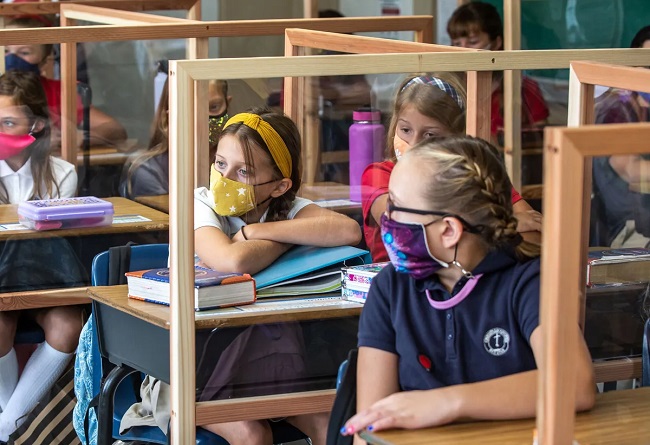
The untold story in America is the Delta variant is ripping through the country. Infections, hospitalizations and deaths are approaching record highs. Super spreader events are the order of the day. And now, they’re opening up schools to millions of innocent, unvaccinated children.

White House COVID-19 test mandate could overwhelm already-strained suppliers

(Reuters) – A White House plan to mandate COVID-19 vaccination or repeated testing for around two-thirds of U.S. workers announced on Thursday could be hampered by supply challenges as COVID-19 test manufacturers strain to keep pace with demand. U.S. President Joe Biden will require all federal employees to get vaccinated against COVID-19 and the U.S. Department of Labor will issue a rule requiring private businesses with more than 100 employees to have their workers vaccinated or tested weekly, officials said on Thursday. Around 25% of the approximately 255 million Americans 18 years of age and older have not yet received a COVID-19 shot, according to federal data. The White House said it will spend nearly $2 billion on 280 million rapid COVID-19 tests to help boost supply, but industry experts are doubtful that manufacturers can produce tests fast enough to keep up with the administration’s mandate.

The U.S. testing industry currently can only produce around 50 million rapid COVID-19 tests each month, said Vijay Kumar, an analyst at Evercore ISI who covers medical technology companies. That’s only enough tests to cover around 12 million people taking weekly tests.

The White House said on Thursday it will employ a wartime law known at the Defense Production Act to help test manufacturers access needed supplies. “It has to be a priority to increase the availability of tests,” said Dr. Amesh Adalja, infectious disease expert at the Johns Hopkins Center for Health Security in Baltimore. “Rapid tests should’ve been available from the very start of this pandemic and the shortages now are unacceptable.”

The largest U.S. manufacturers of rapid COVID-19 tests – Becton Dickinson and Co, Quidel Corp and Abbott Laboratories – did not immediately respond to requests for comment on the White House’s announcement. The Advanced Medical Technology Association, a trade group for testmakers, told Reuters that rapid point-of-care test supplies are still ramping up to meet demand although laboratory-based testing capacity is strong. It added that it sent a letter to the administration in September requesting additional support for test production. U.S. companies have been already been straining to provide COVID-19 tests requested by K-12 schools around the country as they roll out surveillance programs going into the new school year.

CVS Health Corp recently imposed limits on the number of at-home tests customers can buy.The shortages have been compounded because testmakers shut down production lines earlier this year when demand for tests appeared to be slowing and COVID-19 cases were on the decline.Manufacturers have cautioned that supplies could be limited in the near term.

“We’re seeing unprecedented demand as case rates rise,” Abbott told Reuters in a statement in August. “There will be some supply constraints over the coming weeks as increased capacity comes online.” Kumar said that testmakers also need more clarity on how the new mandate will be funded, noting that it is unclear whether employers will be expected to pick up a portion of the costs. The supply issue “won’t be resolved until the test providers have some visibility on demand,” Kumar said.

Biden to mandate vaccine for private sector workers

More than 80 million Americans working in the private sector will be required to receive a COVID vaccine or produce a negative test result at least once a week, a senior Biden administration official said Thursday.

Why it matters: The new rule, to be developed by the Department of Labor’s Occupational Safety and Health Administration (OSHA), underscores the Biden administration’s ramped up efforts to control the virus as cases and hospitalizations largely driven by the Delta variant surge nationwide.

Driving the news: OSHA is developing the rule that will require vaccinations or once a week testing for companies with more than 100 employees, set to be implemented in the coming weeks, per the White House official.

The big picture: The Biden administration unveiled a six-pronged plan to respond to the virus on Thursday, which includes efforts to encourage vaccinations and bolster protections for the vaccinated, among other areas.

  • Health care workers at Medicare and Medicaid participating hospitals and other health care settings — more than 17 million people — will also be required to get vaccinated.
  • The administration is also preparing boosters to start as early as the week of Sept. 20.
  • President Biden will also sign an executive order requiring most federal employees to get the COVID vaccine, without the option of getting regular testing instead, Axios previously reported.

Other components of the six-part plan include:

  • Urging large entertainment venues to require proof of vaccination or testing for entry.
  • Requiring staff in school settings — including at the Head Start programs, youth program personnel at the Department of Defense and at the Bureau of Indian Education-Operated Schools — to be vaccinated.
  • Providing funding to school districts to support reopening, including backfilling salaries.
  • Bolstering COVID-19 testing, including increasing supply of over-the-counter at-home tests, and reducing the cost of at-home tests by ensuring top manufacturers — Walmart, Amazon and Kroger — sell at-cost for the next three months.